

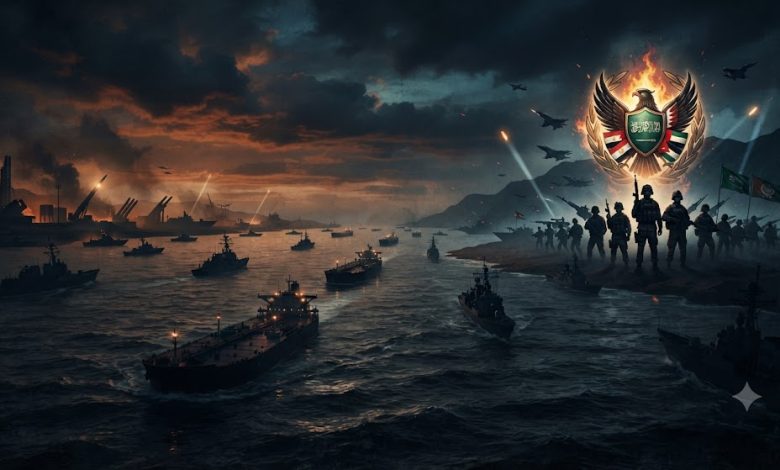
Following recent U.S. strikes, Iran has launched retaliatory attacks targeting U.S.-linked interests in the Middle East. The latest wave of attacks has hit Kuwait, Bahrain, Qatar, and Jordan. With the current fragile ceasefire, these back-and-forth hostilities are narrowing the path toward stability, raising fears of a major regional conflict. Amid these concerns, Arab nations in the Middle East have united to counter Iranian aggression.
The Gulf Cooperation Council (GCC)—comprising Bahrain, Kuwait, Oman, Qatar, Saudi Arabia, and the United Arab Emirates—has condemned Iran’s recent attacks on Saudi and Qatari oil tankers in the Strait of Hormuz, as well as strikes on Bahrain and Kuwait. The alliance labeled these actions as an “unacceptable assault” on the freedom of international maritime navigation and global energy security.
In a statement, the GCC noted that the Iranian attacks targeting the Saudi tanker “Wadiyan” and the Qatari tanker “Al-Riqqa” endangered the lives of sailors. Furthermore, the council stated that Iran’s repeated attacks on Bahrain and Kuwait are a grave violation of international law and United Nations Security Council Resolution 2817, which guarantees safe passage through maritime routes.
The GCC also pointed out that these attacks violate the recent memorandum of understanding signed between the U.S. and Iran regarding the reopening of the Strait of Hormuz and the ceasefire. The coalition reaffirmed the full solidarity of its member states in countering these attacks.
The alliance emphasized that the security of Gulf nations is indivisible. According to the GCC charter and their joint defense agreement, an attack on any single member state is considered a direct attack on the entire alliance. Under Article 51 of the UN Charter, the GCC asserts its right to take any necessary measures and collective self-defense to protect its sovereignty and stability against aggression.
The GCC holds Iran fully responsible for all consequences of these hostile actions. The council warned that Tehran’s destabilizing behavior not only undermines regional and international peace but also puts global energy markets and the world economy at severe risk.
The GCC has called upon the international community, particularly the UN Security Council, to take a firm stand against these attacks. They demanded that the freedom of navigation in the Strait of Hormuz—a pillar of global trade—be ensured without any unilateral restrictions or transit fees, in accordance with the United Nations Convention on the Law of the Sea (UNCLOS).